Capcom Fighting All-Stars: Code Holders (カプコンファイティングオールスターズ) was a 3D fighting game developed by Capcom, planned for release in the Namco System 246 Arcade board. Developed over one and a half year[2], its existence was first revealed in late August/early September, with the announcement of a public beta unveiling in September 21, during the 40th JAMMA "AM Show"[1]. Reportedly, the game received a mostly negative reception from both players and critics alike. Rumors about the game's cancellation first surfaced in February 2003[3], but Capcom didn't confirm termination of the project until the following August, through their official website[4][5]. Finally, the more traditional 2D fighting game Capcom Fighting Jam was released in 2004, referred by its Producer Yoshinori Ono as a "salvaged version" of All-Stars that was "thrown into [Ono's] lap" after another producer left the company half-way through development.[6]
The game played similarly to the Street Fighter EX series, using a 5 button layout (2 punches, 2 kicks and a sidestep). All-Stars used a 3-tiered vitality guage with a "Break Point" instead of rounds, with the defeated character falling down and then recovering to continue the fight. The vitality gauge was tied with the super gauge, called the Progress Super Art Gauge (フログレスS.A.ゲージ), which was split in 3 levels, with the higher-levels only accessed after losing a tier of the vitality gauge (losing one allowed use of the Level 2, losing a second time unlocked Level 3)[7]. The game also included a special evasion move called Dramatic Counter (ドラマティックカウンター), where the character would sway away of an attack to perform a counterattack; and an individual finisher animation called Dramatic Finish (ドラマティックフィニッシュ) for each character, performed at the end of the match against the defeated enemy.[7][8]
There was also a gameplay element known as the "Declaration of Victory", activated by pressing start on the Vs screen[2]: The player would gain additional score points and be able to perform their Dramatic Finish, but in exchange the match would be over if they lose only 1 round instead of the standard 3.[2]
Story and Characters
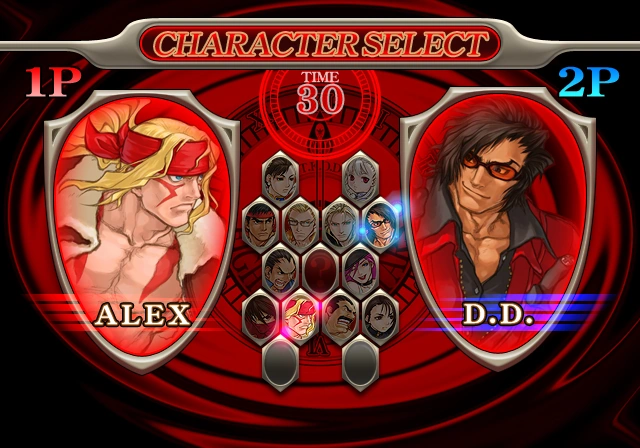

Game's select screen
The story was to be centered on Metro City, the setting of Final Fight. City mayor Mike Haggar received a call from a mysterious man calling himself "DEATH", stating he'd blow up the city with an atomic bomb (anti-proton bomb in the flyer), and he'd have 12 hours to find both him and the three deactivation codes, which were held by three individuals known as the "Code Holders"[7]. The game would have a time limit based on the story, and it would have centered on the Code Holders and specifically on Ingrid and DEATH's relationship[2].
The game featured a total cast of 16 characters[9]. The three Code Holders and DEATH were all original characters:
- D.D. (Code: Ogre). Full name Daisuke Dejima, nicknamed "Crimson Thunder" and identified as "The Goddess of Thunder" (sic) and "Fierce God" in his emblem. Leader of the Code Holders, he's a man clad in a crimson suit with a style focused in powerful, electric-based hits.
- Rook (Code: Fallen Angel), nicknamed "Rebellion Feather" and identified as "Rengoku" and "Fallen Angel" in his emblem. D.D.'s partner, Rook is a blond pale man who fought mostly with kicks, leaving a trail of feathers and light after certain attack.
- Ingrid (Code: Isis), nicknamed "Eternal Ray" and identified as "Eternal Goddess" in her emblem. A young silver-haired girl with sun/light-based techniques. She was ported over to the sprite-based Capcom Fighting Jam, and would later on appear in a few more games.
- Avel (code: DEATH[7]), the owner of the atomic bomb "Laughter Sun" and final boss of the game[2]. Before the game's cancellation only a very brief bio and silhouette of his artwork were revealed[7], with more details and his full artwork published in August 2016 through the official site Capcom Fighters Network[10]. He was also going to be a secret playable character.[9][11]
9 more characters were confirmed before the game's cancelation:
- Street Fighter series: Ryu, Chun-Li, Charlie (Nash), Alex
- Final Fight series: Mike Haggar, Poison†
- Rival Schools series: Batsu Ichimonji, Akira Kazama†
- Strider series: Strider Hiryu
The last two characters on the select screen weren't shown before the end of development, but their official artworks were published alongside Avel's information in 2016, revealing them to be Akuma from Street Fighter and Demitri Maximoff from Darkstalkers.[10]
The final character was, as explained during an interview between Takayuki Nakayama and All-Stars director Toyohisa Tanabe, a guest character from another company[2][9]. As the character is owned by another party their identity was not revealed, but a silhouette of the artwork was provided and Toyohisa stated the character was a "very well known character" from "[his] old place"[2], hinting that it belonged to SNK, where he worked until the company filled for bankrupcy in 2001.
Strider Hiryu
Strider Hiryu was among the confirmed characters for the game, with his appearance and moveset being a mix of both his Marvel vs. Capcom and Strider 2 versions. As seen in the trailers and gameplay videos available, his moveset was much more toned-down when compared to his Marvel vs. Capcom self: Here, his basic attacks were all bare-handed and his Cypher, which rested on his back, was only used in his Special Moves and Super Arts.
During the game's short-lived run, Hiryu was voiced by Kôsuke Toriumi in a reprise of his role in Strider 2[12]. His 2P outfit was modeled after his debut appearance in the first Strider, an idea that'd eventually see the light of day as his DLC costume in Ultimate Marvel vs. Capcom 3.
Hiryu's Moveset
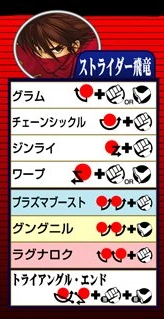

Movelist card
This lists all the known moves Hiryu possessed during the public beta. Some of them can be spotted in the surviving gameplay videos and trailers for the game. The names were displayed in the movelist card sticker used during the beta test (pictured right). Besides these ones, Hiryu also had his trademark "Slide" technique as a dash attack.
Special Moves
- Gram (グラム): Hiryu took out his Cypher and did a slash with extended range. Based off a move from Marvel vs. Capcom.
- Chain Sickle (チェーンシックル): This technique has its name grayed out during the public beta, indicating it wasn't finished or implemented in time. One set of screenshots may show what it'd have looked like, with Hiryu pulling Akira towards him with what appears to be a thin wire, or perhaps a chained Climb Sickle given its name.
- Jinrai (ジンライ): A new attack, Hiryu performed an uppercut with his Cypher, followed by a cartwheel motion in mid-air. Its name means "Thunderclap" in Japanese.
- Warp (ワープ): Hiryu would do a quick teleport to another part of the stage. Also taken from Marvel vs. Capcom.
Super Arts
- Level 1 - Plasma Boost (プラズマブースト): Based off his Boost technique from Strider 2. The attack consisted on two motions: doing the first made the Cypher emit a red glow, and doing the second would make Hiryu swing his weapon and shoot a red plasma wave ahead. Each activation allowed him a total of 5 waves.
- Level 2 - Gungnir (グングニル): An original super art, it's described as a quick auto-combo of kicks and Cypher slashes. It's named after Odin's spear from Norse Mythology, following with the theme naming in Marvel vs. Capcom.
- Level 3 - Ragnarok (ラグナロク): Hiryu would perform a flying dash slash at an airborne enemy, and if it connected he'd follow up with several more coming from different directions, finishing with one going through the enemy from below. A watered-down version of his Marvel vs. Capcom Hyper Combo.
- Dramatic Finish - Triangle End (トライアングル・エンド): Hiryu split into three images/clones of himself, all of which proceed to attack the defeated enemy. After a long string of hits, the three Hiryus would uppercut the opponent high into the air, and finish the attack with a mid-air cross-slash where the three would converge back into one.
Capcom Fighting Jam
Capcom Fighting Jam (カプコン ファイティング ジャム), known as Capcom Fighting Evolution in North America, was released in 2004 as a "salvaged version" of All-Stars, featuring a cast of characters from Street Fighter, Darkstalkers and Red Earth each using the gameplay system from their respective games of origin, plus Ingrid using an unique gameplay style. The game's reception was mostly negative, primarily due to the mishmash of sprites (many of which were ripped straight from earlier games) and lack of competitive balance.
Capcom Fighting Jam has no Strider representation outside of Tong Pooh making a small cameo in Felicia's ending.
Gallery


References
- ↑ 1.0 1.1 Funatsu, Minoru (September 4, 2002). Capcom, Return of JAMMA Show. Title is "Capcom Fighting All-Stars" (Japanese). GameWatch. Accessed August 5, 2016
- ↑ 2.0 2.1 2.2 2.3 2.4 2.5 2.6 Nakayama, Takayuki (November 17, 2017). "Fighting All-Stars" (English). Capcom Fighters Network official site. Retrieved December 9, 2017
- ↑ Varanini, Giancarlo (February 26, 2003). Capcom cans All-Stars (English). GameSpot. Retrieved October 7, 2013
- ↑ Capcom (August 7, 2003). (Notice) Related to End of Development (Japanese): Capcom Official Website. Retrieved from Archive.org. Accessed October 7, 2013
- ↑ Niizumi, Hirohiko (August 5, 2003). Capcom Fighting All-Stars cancelled, again (English). GameSpot. Retrieved October 7, 2013
- ↑ Staff (January 2008). World Exclusive - The Big Comeback. EGM (224). Pg. 64.
- ↑ 7.0 7.1 7.2 7.3 7.4 Capcom (September 2002). AM Show Game Flyer (Japanese)
- ↑ Jeff Gertsmann (September 19, 2002). JAMMA 2002 Hands-on: Capcom Fighting All-Stars (English). GameSpot. Retrieved October 7, 2013
- ↑ 9.0 9.1 9.2 Nakayama, Takayuki (August 11, 2021). "Nakayama's twitter" (Japanese). Accessed August 14, 2021.
- ↑ 10.0 10.1 Nakayama, Takayuki (August 5, 2016). "Treasure Museum Extra Edition: Capcom Fighting All-Stars 2nd part" (Japanese). Capcom Fighters Network official site. Retrieved August 5, 2016
- ↑ Nakayama, Takayuki (August 4, 2021). "Nakayama's twitter" (Japanese). Accessed August 14, 2021.
- ↑ Kôsuke Toriumi's Personal Data page (Japanese). Artsvision official site. Retrieved from Archive.org. Accessed August 5, 2016