| Main | Development | Reception | Gallery |
|---|
Strider 2 started development following Hiryu's renewed popularity in the first Marvel vs. Capcom[1]. Coinciding with the 10th Anniversary of the first game, the project was developed by Capcom's Production Studio 1[1] and designed primarily by Atsushi Tomita, who previously worked as the main designer in X-Men vs. Street Fighter and its following two sequels, Marvel Super Heroes vs. Street Fighter and Marvel vs. Capcom: Clash of Super Heroes.
Development History
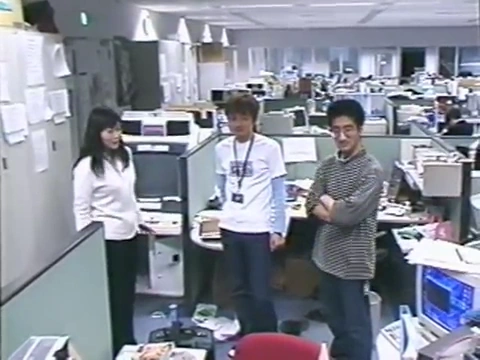

Character designer Masanori Kondo and planner Atsushi Tomita standing in Production Studio 1's workstation
Resurrecting the Strider series was made possible due to Hiryu's increased popularity/recognition after his playable appearance in Marvel vs. Capcom. Tomita presumes there were some calculations internally that yielded good enough results to attempt an "experimental work"[1]. According to Tomita, originally Capcom wanted Strider 2 to be created by recycling Hiryu's assets from Marvel vs. Capcom, as a way to reduce costs[2]. Tomita felt a bit of jealousy at the staff in charge, but also wondered how they'd make this crazy idea work[2]. While creating games in this method wasn't uncommon (Tomita citing Cyberbots, who reuses the mecha sprites from Armored Warriors, and Pocket Fighter being based on the artstyle and sprites of Puzzle Fighter), he considered that using assets created from a completely different system would cause a lot of trouble.[3]
And as Tomita predicted, the project showed signs of trouble and he joined midway through it due to "some circumstances"[2][4], having previously mentioned that joining as "assistant designer" was traditionally done when a game line was in trouble[1]. The troubled production was caused by several different reasons, some listed included a lack of personnel, staff dropouts, and heated arguments during meetings[5]. And as they had to create Hiryu's sprite from scratch, they couldn't make any saving costs in that front either.[3]
At one point, as the project showed little signs of progress, Tomita was called in by the Junior Producer. He warned him that the project could be cancelled, but wanted to know from him if it could reach completion. Tomita was reluctant to see Strider 2 cancelled, and he eagerly told the producer they "can do it". Working side-by-side with his staff, Tomita was able to complete a playable demo of the game in time for the 1999 E3 Show[1]. Reactions from the public at the convention were lukewarm at best, noting it still required a lot of work and polish. Tomita felt he couldn't argue against the criticism since the prototype wasn't ready, and his team was "depressed" while working on it.[1]
In spite of this, Tomita soldiered on intent on seeing the game completed[1]. From this point forward, there's little known about the game's development, though it can be inferred to have been just as difficult. Tomita has claimed several times that he has forgotten everything up until the game's release, and that his brain "rejects him" when he tries to remember.[1][5][6]
Promotion
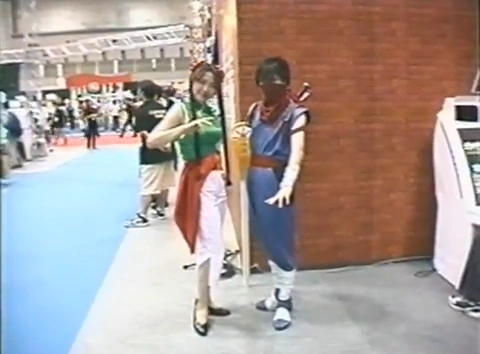

Capcom employees dressed as Hiryu and Tong Pooh during the AM Show
Rumored to exist since at least December 1998[7], Strider 2 was publicly revealed in February 1999 at the Japanese AOU Show in the form of a 20-second teaser video[8][9]. A second in-progress teaser was included in the VHS "Capcom Friendly Club Video vol. 10", released in the Capcom-produced official magazine CFC Style Fan-Book Cap![10]. In both instances, the game used a placeholder "Strider Hiryu" tentative title and logo.
The first public playable demo of Strider 2 was made available during the May E3 Show[11]. The demo covered only the entirety of the game's 2nd stage, Fortress Wahnen. Later in September, Strider 2 appeared during the Japanese JAMMA AM Show, in the form of a playable demo reportedly in a 50% completion state[12][13]. During the event, official Capcom cosplayers dressed as Hiryu and Tong Pooh were seen around the stage floor promoting the game.[14]
The game was finally released in December 1999, despite rumors it would not see release until 2000.[11]
Influences
When designing Strider 2, Tomita sought to maintain the feeling of old-school Arcade games and aimed to create an interesting Arcade title by combining elements from the first Strider in a way more suitable to contemporary times. He considered it important to have the ambition to challenge the previous game's limits, as otherwise the project would risk becoming an entirely different game[1]. Art director Sho Sakai considered satisfying the diehards the hardest thing, thinking that the team needed to strike a balance as making the game too similar to Strider wouldn't be interesting, but changing too much would alienate long-time fans[15]. The solution reached was to remake the original game, introducing new elements together with retreads of memorable locations, set pieces and bosses.[15]
That thinking led to the decision to incorporate 2D sprites with 3D polygonal models and backgrounds, going beyond the limits of the previous game's action[1]. Sakai said that the confluence of 2D and 3D was a key aspect of the title, and the move to 3D backgrounds allowed them to make stages more than just "basic linear horizontal traversal against a backdrop".[15]
Characters
While Hiryu's overall look and movement were inspired by his Marvel vs. Capcom self, the game's main illustrator Harumaru didn't base his portrayal in this version, instead drawing him based on advice given by Shoei Okano, who described Hiryu as a "crazy-style" protagonist who will carry out any mission he's given "mechanically". As a result of this, Harumaru considers the Hiryu from Strider 2 different in his expressions and feelings to the one from the Versus series.[16]
Hiryu's lines were written by Tomita, as he did previously for Hiryu in Marvel vs. Capcom: Clash of Super Heroes[17]. He didn't have much trouble writing his lines for Marvel, but when it came to Strider 2, figuring out how to portray him became a major challenge[18]. As he considered the original Hiryu (both in the manga and Arcade) a pretty straightforward hero type, for Marvel he expanded on Hiryu's "sharp tongue" and wrote him like a character with a strong sense of professionalism[17]. For Strider 2, he went further, writing Hiryu as someone who feels there are no shared values with his opponent and, as such, there's no point in speaking with them[17]. He noted he went the Golgo 13 approach of not showing any inner thoughts[18], and was also inspired by the dialogue Yoshiki Okamoto wrote for Forgotten Worlds, Capcom's first CPS-1 Arcade game. Akiman told him that Okamoto realized strong visuals wouldn't be able to carry the cutscenes alone, and so he came up with the game's amusing dialogues. Tomita worked hard to create similar memorable lines in Strider 2.[19]
Several of the character designs became important in portraying the game's worldview; with the enemies that formed the Superhuman Army being one of the major factors in representing this world[20]. Several of the side characters were created seemingly to fill similar roles to characters from the first game, such as a patriotic madman (Mikiel/Schlange), a ruthless captain of a flying fortress (Beard Jr./Wilhelm), etc.
The design of the game's robot and machine enemies sought to surpass the unique robot designs of the original, albeit the artists were well aware this time most of these characters would need to be recreated as polygonal 3D models as well[20]. Bosses were another key aspect of the title according to Sakai, who considered them an important part of the original game and how their highly original designs made them memorable and impactful even if they were quickly eliminated[15]. As such, the staff made sure bosses in Strider 2 were as over-the-top and impressive as those from Strider.
World Setting
The dystopian world of Strider 2 has been described as a combination of the catchy quirkiness often seen in Capcom characters and the hard tones reminiscent of American comic books[21]. Having been told to draw "a new approach, never before seen from Capcom", artist Harumaru struggled to find the direction for the game's world view, and finally settled on incorporating a new style while trying to inherit the elegance of the previous game's design[21]. When drawing the game's set pieces, Harumaru was inspired by several American comic books found in the design office, naming specifically works from DC Comics, Mike Mignola, Simon Bisley and Todd McFarlane's Spawn.[16]
Atsushi Tomita initially believed he had no choice but to make the game a remake of the original Strider, and as such it was initially developed under that mindset rather than as a direct sequel[22]. This is the reason he brought back characters like Tong Pooh and Solo and stages like the Balrog and Third Moon[22]. At some point in development, however, Producer Noritake Funamizu requested him to rename the game "Strider 2"[22]. This decision made having to fit everything consistently a difficult task[21], so Tomita decided to switch the story to be about "someone recreating the world"[22]. His idea was that Hiryu failed in his mission to kill Meio in the original game, allowing him to eliminate all life on Earth and recreate the world as he planned[23]. Tomita, however, later stated that he worked under the hypothesis that, in action games like this one, elements such as the world or its narrative are forged between the player and the game[21], seemingly prefering to leave the details up to interpretation.
Music
The video game's original soundtrack was composed by Setsuo Yamamoto and Etsuko Yoneda.
When talking about the game's score, Yamamoto said that, while he was well aware of the original score, he didn't felt necessary to draw too much from it, preferring to create compositions with his own personal approach[24]. Due to the original music's reputation, he felt it became more of a burden as well. He was also requested by the planners to make some of his themes more "movie-like", which despite going against the flow of a side-scrolling action game he still enjoyed composing.[24]
The core concept behind the composition was Hiryu's personality, something he believed would give his work a "different flavor" from that of the original score. The game's opening song was especially difficult because it'd determine the score's overall direction, and so took a long time to compose. The music identifies Hiryu less as a hero and more as an "assassin living only to fulfill his assignment"[25]. Other themes were inspired by Hiryu's feelings or specific moments: The first Balrog theme was inspired by Hiryu's determination and resolution to face his enemies, while the boss themes for stages 3 and 5 were based on Hiryu's bravery when facing huge, mysterious creatures like the Kraken and Caduceus.[25]
Ports
Dreamcast
Early reports about the game running on Sega's Naomi board circulated gaming websites before its official reveal at the AOU Show, seemingly claimed by a Japanese listing of upcoming Arcade games[26]. As the Naomi board was based on the Dreamcast's architecture, most websites eagerly concluded that a Dreamcast port was "guaranteed"[8][27]. Capcom never confirmed these rumors in any official matter, and they were eventually disproven during the game's AM Show appearance.[28]
In the end, Strider 2 was developed for Sony's ZN-2 board, which was based on the PlayStation, making it the platform of choice for porting.
PlayStation
Hinted at from an early date[5], the PlayStation port of Strider 2 was released two months after the Arcade game in February 2000. It included a second disc with a port of the first Strider and several bonus features, such as a playable Hien and an extra "Mission 00", a stage which was worked on for the Arcade but ultimately cut.[5]
The game's English version was announced shortly afterwards, planned for a May 2000 release[29]. It was ultimately delayed, attributed to being caught up in "shipping and distribution channels" according to Capcom, and finally released two months later, in July[30]. There are no major differences with the original version, and the only notable change is the removal of the Japanese voices during cutscenes, leaving the characters silent.
The English release also suffered from a printing oversight in which both disc labels were reversed: the disc labeled "Strider" is actually Strider 2 and vice versa.[31]
This compilation port was included as a download code in Japanese PlayStation 3 copies of the 2014 Strider and later made available for purchase through PlayStation Network in both Japan and America, accessible on the PlayStation 3, PlayStation Portable and PlayStation Vita.
References
- ↑ 1.00 1.01 1.02 1.03 1.04 1.05 1.06 1.07 1.08 1.09 Yamamoto, Setsuo; Yoneda, Etsuko (January 21, 2000). Strider Hiryû 2 Official Soundtrack. [CD]. Suleputer, CPCA-1035. Liner Notes, pg. 4-5.
- ↑ 2.0 2.1 2.2 Tomita, Atsushi (September 17, 2024). "Tomita's Twitter (Japanese). Accessed October 27, 2024
- ↑ 3.0 3.1 Tomita, Atsushi (September 17, 2024). "Tomita's Twitter (Japanese). Accessed October 27, 2024
- ↑ Capcom (2014). "Launch Celebration Comments from Past Special-A Class Striders". Capcom's official Strider site (Japanese). Retrieved from Archive.org. Accessed January 14, 2024.
- ↑ 5.0 5.1 5.2 5.3 Capcom (1999). Capcom Secret File #26: Strider Hiryu 2 (Japanese). Pg. 11
- ↑ Capcom (1999). Capcom Secret File #26: Strider Hiryu 2 (Japanese). Pg. 8
- ↑ IGN Staff (December 1, 1998). "Strider 2 Rumors Abound". IGN. Accessed December 5, 2013
- ↑ 8.0 8.1 EsquE (February 9, 1999). "AOU Show". dc-extreme.com. Accessed December 5, 2013
- ↑ Sewart, Greg (February 17, 1999). "Dead or Alive 2 Screens". gaming-age.com. Accessed from archive.org. Retrieved December 5, 2013
- ↑ Dissidia (February 25, 2022). "VHS Capcom Friendly Club CFC Video Vol. 10 | カプコンフレンドリークラブ CFC ビデオ Vol. 10" (Japanese). Published on Youtube.com. Accessed October 27, 2024
- ↑ 11.0 11.1 IGN Staff (May 12, 1999). "Capcom's Secret Games". IGN. Accessed December 5, 2013
- ↑ (September 22, 1999). "37th Amusement Machine Show Report" (Japanese). Accessed December 5, 2013
- ↑ (October 5, 1999). "37th Amusement Machine Show Report" (Japanese - dead link). Accessed December 5, 2013
- ↑ Harumaru (February 3, 2019). "Harumaru's twitter" (Japanese). Accessed April 20, 2020.
- ↑ 15.0 15.1 15.2 15.3 Jones, Darran (March 2014). "The Story of Strider". Retro Gamer (126). Pg. 39
- ↑ 16.0 16.1 Capcom (March 10, 2014). "Capcom Legends Chapter 3: The Running Ninja from the Future, Hiryu!" (Japanese). Capcom's official site. Retrieved from Archive.org. Accessed April 16, 2021
- ↑ 17.0 17.1 17.2 Tomita, Atsushi (November 5, 2024). "Tomita's Twitter (Japanese). Accessed November 14, 2025
- ↑ 18.0 18.1 Tomita, Atsushi (June 14, 2025). "Tomita's Twitter (Japanese). Accessed November 14, 2025
- ↑ Tomita, Atsushi (March 1, 2025). "Tomita's Twitter (Japanese). Accessed November 14, 2025
- ↑ 20.0 20.1 Capcom (1999). Capcom Secret File #26: Strider Hiryu 2 (Japanese). Pg. 3-4
- ↑ 21.0 21.1 21.2 21.3 Staff (June 2000). "Strider Hiryu 2: Setting Document (Part 2)" (Japanese). Monthly Arcadia (06). Pg. 180.
- ↑ 22.0 22.1 22.2 22.3 Tomita, Atsushi (June 18, 2025). "Tomita's Twitter (Japanese). Accessed June 28, 2025
- ↑ Tomita, Atsushi (June 18, 2025). "Tomita's Twitter (Japanese). Accessed June 28, 2025
- ↑ 24.0 24.1 Staff (2000). "Interview #1: Setsuo Yamamoto". Suleputer official site. Accessed from archive.org. Retrieved November 04, 2015
- ↑ 25.0 25.1 Yamamoto, Setsuo and Yoneda, Etsuko (January 21, 2000). Strider Hiryû 2 Original Soundtrack. [CD]. Suleputer, CPCA-1035. Liner Notes, pg. 3.
- ↑ Staff (February 9, 1999). "Naomi Games due in 1999". segatech.com. Retrieved from Archive.org. Accessed April 16, 2021
- ↑ Sewart, Greg (February 8, 1999). "Strider 2 on the Naomi Board". gaming-age.com. Accessed from archive.org. Retrieved December 5, 2013
- ↑ Ohbuchi, Yutaka (September 9, 1999). "JAMMA Show: Capcom". gamespot.com. Accessed December 5, 2013
- ↑ IGN Staff (March 1, 2000). "Strider 2 Sneaks into Us". IGN. Accessed December 5, 2013
- ↑ IGN Staff (July 13, 2000). "Strider 2". IGN. Accessed December 5, 2013
- ↑ IGN Staff (July 29, 2000). "Strider 2 is a Little Kooky". IGN. Accessed December 5, 2013
| The Development of Strider | |
|---|---|
| Development sub-pages | Strider (CPS-1) • Strider (NES) • Strider (Mega Drive) • Strider II Strider (PC Engine) • Strider 2 • Strider (2014) |
| Prerelease content | Strider (CPS-1) • Strider (NES) • Strider (Mega Drive) • Strider 2 • Strider (2014) |
| Unused content | Strider (CPS-1) • Strider (PC Engine) • Strider (NES) • Strider 2 • Strider (2014) Unused enemies • Unused stages |
| Cancelled games | Strider Hiryu (Famicom prototype) • Untitled game projects • Untitled GRiN Project |
| Related | Cannon Dancer (Prerelease content • Unused content) Isuke's scenario draft |