| Main | Development | Reception | Gallery |
|---|


Cannon Dancer - Osman became the 4th video game developed by Kouichi Yotsui for Mitchell Corporation, as well as the final game he directed before leaving the company. He worked together with Takashi Kogure ("Utata Kiyoshi"), an artist and close friend he met at Takeru who has worked with him on several projects including Nostalgia 1907 and The Karate Tournament[1][2]. Yotsui remembered being told to "Make a game like Strider" the moment he joined the company[3], and so Cannon Dancer imitates the style, gameplay and structure of his most popular work. The similarities are to such a degree Cannon Dancer was called "Strider Hiryu Part II" within its staff[4], and years later it is still acknowledged as one of its best spiritual successors.
Development
Cannon Dancer began development at some point around late 1994/early 1995[5]. Back then Mitchell Corp's financial situation was on the decline as they struggled to produce a game that could become a hit in the larger overseas market similar to their initial success with the Buster Bros. series[4]. At the time staff members were given complete freedom to develop games within a specific framework established by the company, but this only led to producing quirky Arcade games that didn't mesh well with overseas trends[4]. It was in this situation that Isuke received a request: to make "something he was good at"[1], to "compete in his favorite genre"[4]. Having always desired to make a successor to Strider, and thinking that "doing what he wanted" got Mitchell in trouble[1], Yotsui set out to develop Cannon Dancer by putting all of himself[3], stating that he usually wants to create a game in a different genre when he finishes a project, but when it came to Strider he wanted to make a "continuation" right away, as he felt it was "not completed perfectly" and he was eager to apply the experiences he gained from both his successes and failures into it.[6]
Yotsui, however, was worried about the time period and the trends at the time: the growing popularity of fighting games was displacing single-player action games, and the coming of 3D games was doing the same to 2D pixel-based games; so he felt he was at a time between periods and this could become a "commercial disadvantage"[6]. Other difficulties he mentioned during development included tight schedules and low budget, as well as limitations in the technology they were using.[7]
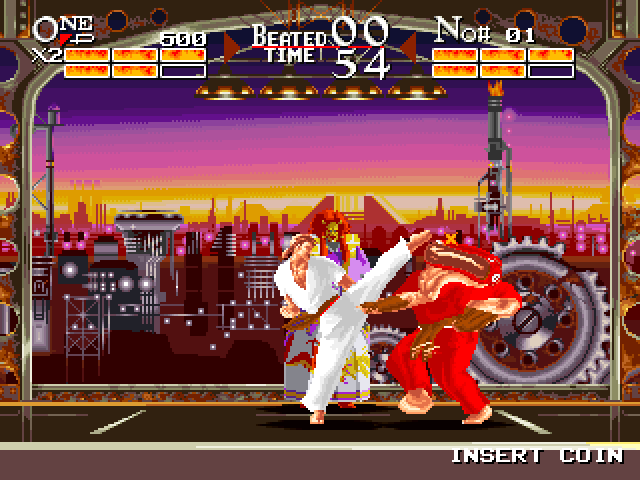

The blur effects in The Karate Tournament helped in creating Cannon Dancer's unique look
Cannon Dancer was developed on the "Simple 156" Arcade hardware, manufactured by Data East[8]. Wanting to express a "beautiful feeling" through pixel work, Yotsui worked closely with Utata Kiyoshi, taking the experience and new techniques he developed working on The Karate Tournament and its unique blur motion attacks[1][5]. This was best reflected in Kirin' smooth animations and movements, which were translated into more than 1600 drawn pixel patterns[5]. The technology's limitation was a constant worry, with Kiyoshi saying they were so concerned over Kirin's animations that they put pressure on the ROM capacity for the whole game.[7]
Isuke also worked on the graphics, doing mostly backgrounds and concept drawings for the larger, more bizarre characters[2], trying to express his feelings through them. He did it himself because he didn't want to explain why he needed certain elements of their designs (such as the statue and cars on Material), saying "You never have to explain yourself if you do it yourself"[3]. According to Utata Kiyoshi, Yotsui often didn't explain anything about the characters, for example never clarifying whether Slaver was a true deity or not.[9]
When working on the stages Yotsui wanted to load the game with "one-time only mechanics" and entertain players by giving them surprises at every step of the path, the same philosophy he used while developing Strider. He believes once a gameplay system is established it quickly becomes outdated, and so he always strives to establish something completely new, thinking progress is normal and if a game lacks surprises it loses its appeal[6]. The gameplay in Cannon Dancer went through several iterations during development, as initially, it featured special motions and commands that resembled fighting games, particularly those from Capcom[10]. Kirin's special move was also initially a multi-input move that required several motions in order to pull off.[10]
In March 1995, right in the middle of development, the terrorist Subway Sarin attacks happened in Tokyo. Yotsui and the staff were shocked that a religious cult would actually go that far and worried over the similarities with the game's plot involving a terrorist cult taking over a city, fearing it may lead people to believe they were referencing the event despite the game being in development long before that[5]. In the end, no noteworthy parallels were drawn between the event and Cannon Dancer.
Influences
As stated previously, Cannon Dancer was developed by Isuke as a successor to the original Strider, even calling it "his own" version of Strider 2. It shares a lot of elements in common, ranging from gameplay elements, moves, items and stage settings to similar plot elements and enemy concepts. Yotsui said that the biggest influence he took from Strider was its freedom of movement and "vertical agility", as well as the high-speed movement and "destruction with no time lag" after hitting the attack button[11]. At a later time Isuke came to say that he felt "tired" during production and that he felt very little pressure, as he was not doing something new and was just on a "road he was familiar with", cutting corners and making it "kind of strange" instead[1][6]. He referred to it as a "self-parody" of Strider[1][3], explaining that there's nothing really new or original about it, although he still thinks it is a good game[3], being particularly proud that Cannon Dancer is a "high-end tableau for 2D and dot art games", a genre of games that are in decline following the advance of technology in the industry.[7]
A major influence on the game's visuals comes from the cyberpunk sub-genre of science fiction, which Yotsui thinks is best noticed in the first two stages[3], set on a high-tech city at night. Yotsui got the inspiration for Stage 4's ocean section from a scrapped raft-based stage concept Tokuro Fujiwara intended to implement in Ghouls 'n Ghosts[3]. Other influences for the game's artwork as stated by Isuke include the adventure novels from Wilbur Smith, the science-fiction novels written by Larry Niven and Carl Jung's theory of archetypes.[7]
It's commonly asserted that Cannon Dancer was based on Yotsui's real-life experiences while working at Capcom, but he has denied this to be true and expressed genuine surprise at the notion.[3]
Characters
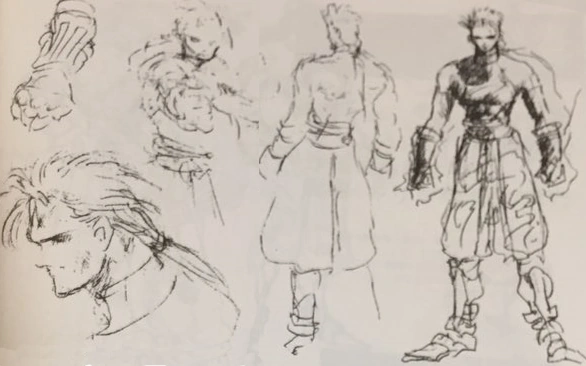

Kirin's first sketch
Kirin's design didn't change much during development, staying mostly intact from beginning to end. Utata Kiyoshi revealed the novel The Fist of God as the inspiration behind making Kirin exclusively a bare-fisted fighter[10]. Kirin's gameplay, on the other hand, went through a number of iterations before settling on the one in the released game, and initially closely resembled fighting game commands and moves, particularly from Capcom[12]. Due to Kirin's brightly-colored pants and obi, it is often assumed he is Arabic in design, but Utata Kiyoshi instead inspired Kirin's design in the attire of a Japanese steeplejack, and added the impressive embroidery of the pants and the obi as a way to make his silhouette stand out.[11]
The warriors of Teki were initially planned to be playable, but after running into problems having to adjust multiple playable characters, the idea was scrapped and they instead became rivals opposing Kirin in the story. Their designs were the result of an internal contest: Isuke would announce a one-sentence description for each character and staff members would create designs based on that and then choose the best one to be used[13]. Boss characters were designed in a similar way, with Yotsui's designs being often selected. He thinks this resulted in a very diverse cast that was the culmination of everyone's ideas.[7]
A very early proposal for the setting was that Kirin was a warrior that "governed over the blue dragon" and faced a rival that similarly drew power from the white tiger, in reference to the Chinese Four Beasts[14]. Although the idea was scrapped elements from it still survive as part of the final design, like Kirin's dragon imagery on his blue pants or Tianon's cape featuring the image of a bird/phoenix in reference to the Red Vermillion.
World setting
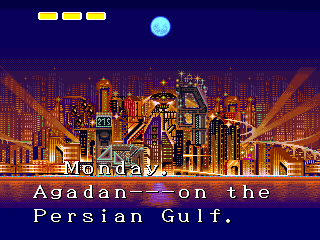

The city of Agadan
Cannon Dancer is often described as being in a futuristic, "cybernetic" Arabian or Middle Eastern setting, but this was not the original intent. Utata Kiyoshi explains they didn't intend to create an Arabian setting, but were conscious they needed to create a "near-future, stateless image", while Yotsui wanted to create an adventure "in a world and landscape not often featured in movies and games of the time"[7][11]. This is the same reasoning Isuke used behind the Russian settings in Strider.
When asked about the plot of Cannon Dancer, Yotsui explained that Arcade games aren't the place for "redundant stories" due to a lack of time for expressions; as such, he believes it is important to strongly establish a world in the limited time allowed in a way to make the story work or to foreshadow intense drama in future parts. He compares this approach to poetry in contrast to literature, stating that it "must make you want to see more of the world, drama and story" that lie beyond the few minutes of playtime.[11]
Cannon Dancer has a number of ties in its story to Strider, implying they are part of an unofficial "shared universe". When discussing this, Isuke said that he likes games that "exude their creator's individuality", in a similar way to how a film's director leaves its imprint on a film's style without appearing on-screen. As he takes his "individuality" when developing a game with the same style as Strider, he thinks whether or not Cannon Dancer is a direct sequel is trifling. Given the nods and connections, however, he does admit it can be called an "irregular sequel"[15], and in later years came to call it "his" Strider 2.
Music
The game's soundtrack was composed by Yusaku Aoki under the pseudonym Tago Saku[2]. Due to the Arcade hardware's low specs, Saku worked on the soundtrack all alone and was given complete freedom to do so by Yotsui. The music takes after Isuke's love of more "exotic" and obscure worldviews, believing he and Taku took this direction over his love of Indonesian Kecak music[2]. Some of the themes Aoki produced were inspired by both Kecak and Buddhist scriptures (Kannon Sutra), lending it to have an "arabic melody"[16]. It was Aoki who proposed that "sutras can be music", to which Yotsui fully agreed; also adding that he gave Saku little direction and that the soundtrack is all Saku's taste.[2]
A few of the music themes in Cannon Dancer were actually first heard in Isuke's previous title, Demon Mirage Mahjong, including the Slaver chanting theme.[17]
Cannon Dancer was the last video game score composed by Aoki as a professional.[16]
Localization
Cannon Dancer was originally released overseas under the name Osman. According to Isuke, the decision for the name change in English came from Mitchell Corp's president Roy Ozaki[7]. Roy Ozaki has said that he choose "crazy names" for his games as a way to avoid legal issues, citing that Nintendo has "50 lawyers" to check names but as he couldn't afford that much he instead came up with untested crazy titles to avoid the issue entirely[18]. For the 2023 release, the name was reverted to Cannon Dancer for all markets, with Osman relegated to a subtitle instead.
During localization, Cannon Dancer had no changes or alterations made to its graphics and gameplay. Its translation, however, changed and modified some lines that made the game's plot even harder to follow. In particular, this led to the removal of specific dialogue choices in regard to the Teki's alternative boss order: in Cannon Dancer, each Teki has 3 unique dialogues when faced as a boss in Stages 3, 4 and 5 respectively, but in the English translation they were reduced to a single unique dialogue for each Teki when faced in Stages 3 or 4, and one shared generic line all of them use in Stage 5.
The English version also saw the addition of a short tutorial demo at the beginning of the game, displaying basic controls and moves in front of a black screen.
Ports
Due to a small number of Arcade units being produced and the huge popularity of 1-on-1 fighting games at the time, Cannon Dancer quickly faded out of Arcade centers without getting ported or released on home consoles[19]. According to Mitchell's CEO Roy Ozaki the game did "alright" in Japan, but fared worse overseas[8]. Over time it developed a reputation as a lost "video game legend".[19]
Modern release
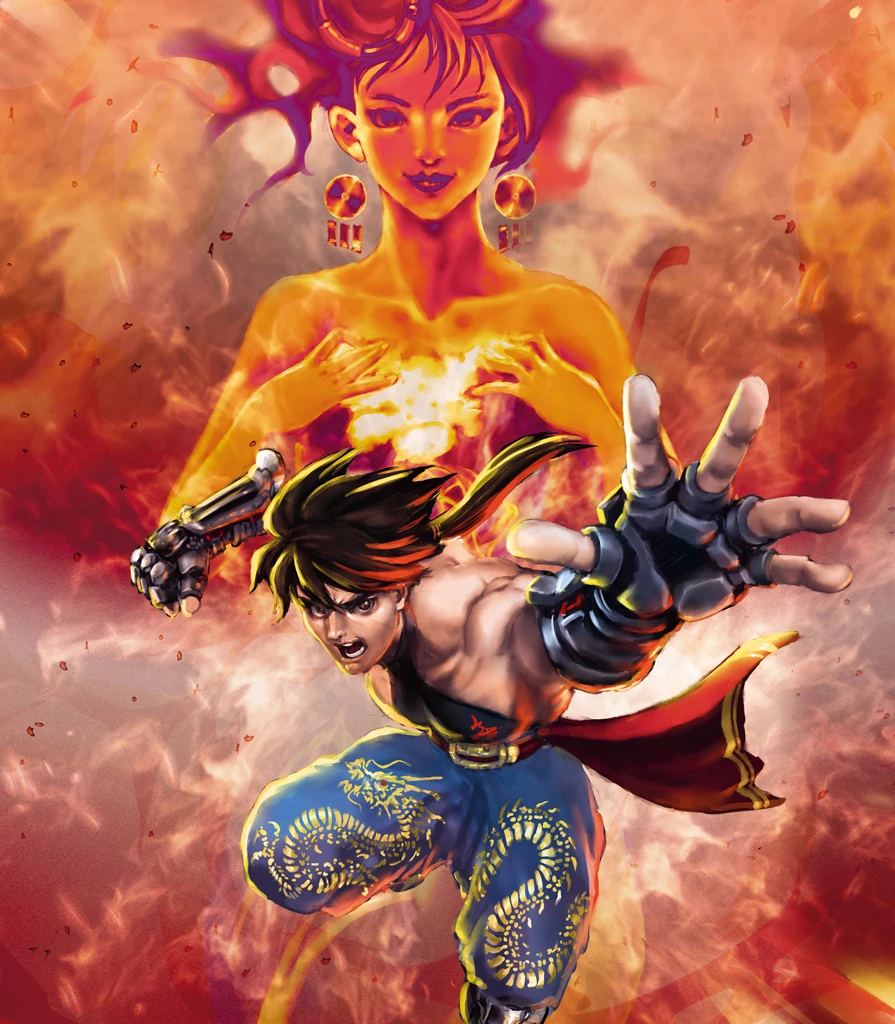

Rerelease key artwork, by Utata Kiyoshi
In 2014 Roy Okazi stated in an interview that he was looking for partners to license the company's back catalog of video games, which included Cannon Dancer[20], although nothing appeared to come out of this. Strictly Limited Games started working on bringing back Cannon Dancer around the year 2018[21], with Yotsui stating he was first contacted by Roy Ozaki and Dennis Mendal from UGE at around that time, after which he didn't hear news until 4 years later when the game was ready to be announced[2]. Yotsui was particularly happy they were able to release it as a passion project, as he has been approached for licensing Cannon Dancer during the past 20 years, but talks often fell to the wayside when money was discussed.[2]
An initial hint of Cannon Dancer getting a modern rerelease came out when it appeared as part of the third-party game lineup in display at Konami's booth in the September 2022 Tokyo Game Show event[19]. It was shortly after officially announced by developer ININ Games under the unified rebranded title Cannon Dancer - Osman[22], being developed under license from Mitchell Corp despite the company being inactive since 2012[23]. Both Isuke and Utata Kiyoshi came together to assist ININ Games in the rerelease, producing brand new official artwork and appearing in a meet and greet held at the event were they signed artwork and chatted with people.
Cannon Dancer was released on April 2023 as a digital release in all regions on PlayStation 4, PlayStation 5 and Nintendo Switch; with a Xbox One and Xbox Series version released outside Japan. A standard physical Limited Edition was released in January 19, 2023, developed by Strictly Limited Games for PlayStation 4, 5 and Switch and came with the game, a printed manual, a boxart with concept art and a print of Tianon's telephone card art.
A second, Collector's Edition has also been released including the following goods:[22]
- Collector's Edition box, physical game and manual.
- 32-page "Material" artbook with concept art by Utata Kiyoshi, including never-before seen pieces.
- A soundtrack CD.
- Tenugui (short hand towel) using the game's key artwork.
- 2023 Calendar and photo frame.
- Acrylic diorama featuring the four members of Teki.
- A metal "Arcade Coin" collectible with the Kanji for "nothingness" (the one featured in Kirin's chest).
- Postcards, a reversible poster, Arcade marquee sticker and flyers.
The Japanese market instead received a "Special Pack" (スペシャルパック) physical release by ININ Games that only includes the box, artbook and tenugui towel.


References
- ↑ 1.0 1.1 1.2 1.3 1.4 1.5 Tane, Kiyofume (February 2009). "The Father of Strider Who Made the Game World Explode: Kouichi Yotsui Discography". Gameside (16). Translated by Gaijin Punch for Gamengai. Retrieved from Archive.org. Accessed February 2, 2023.
- ↑ 2.0 2.1 2.2 2.3 2.4 2.5 2.6 Yotsui, Kouichi; Kogure, Takashi (April 13, 2023). Cannon Dancer Material Book, "Kouichi Yotsui & Utata Kiyoshi Cannon Dancer Dialogue" (English). Included with the Collector's Edition of Cannon Dancer. Pg. 68-73.
- ↑ 3.0 3.1 3.2 3.3 3.4 3.5 3.6 3.7 Szczepaniak, John (February 21, 2018) The Untold History of Japanese Game Developers: Volume 3. Pg. 498-499. ISBN 0-99-292608-4
- ↑ 4.0 4.1 4.2 4.3 Game Area 51 (May 29, 2011). "Utata Kiyoshi Artdot Works" (Japanese). Pg. 10.
- ↑ 5.0 5.1 5.2 5.3 Game Area 51 (May 29, 2011). "Utata Kiyoshi Artdot Works" (Japanese). Pg. 13.
- ↑ 6.0 6.1 6.2 6.3 Patterson, Mollie (January 19, 2023). "After nearly 30 years, creator Kouichi Yotsui finally gets to see his groundbreaking Cannon Dancer come home" (English). egmnow.com. Accessed February 2, 2023
- ↑ 7.0 7.1 7.2 7.3 7.4 7.5 7.6 Packwood, Lewis (January 4, 2023). "Ultimate Guide: Cannon Dancer". Retro Gamer (241). pp. 61.
- ↑ 8.0 8.1 Seydoux, Chaz (January 16, 2006). "shokkingu hitofude" (English). Insert Credit. Retrieved from Archive.org. Accessed February 2, 2023.
- ↑ Game Area 51 (June 11, 2011). "Utata Kiyoshi Artdot Works [Interview Side]" (Japanese). Pg. 8.
- ↑ 10.0 10.1 10.2 Game Area 51 (May 29, 2011). "Utata Kiyoshi Artdot Works" (Japanese). Pg. 18.
- ↑ 11.0 11.1 11.2 11.3 Hagues, Alana (January 5, 2023). ""Arcade Games Are Poetry" - 'Strider' Director On The Return Of 'Cannon Dancer'" (English). nintendolife.com. Accessed February 2, 2023
- ↑ Game Area 51 (May 29, 2011). "Utata Kiyoshi Artdot Works" (Japanese). Pg. 19.
- ↑ Game Area 51 (May 29, 2011). "Utata Kiyoshi Artdot Works" (Japanese). Pg. 25.
- ↑ Game Area 51 (March 5, 2020). "Area51's twitter" (Japanese). Accessed February 2, 2023.
- ↑ Scion; Dire 51 (24 April 2010). "Interview with Kouichi "Isuke" Yotsui". LSCM 4.0. Translated by Gaijin Punch. Accessed February 3, 2023.
- ↑ 16.0 16.1 Tago Saku (Tagosaku A) comments posted on the YouTube video "Cannon Dancer / Osman Soundtrack" on December 4, 2020.
- ↑ Mudana Doryoku (May 15, 2021). "A treasure trove of hilarity! Demon Mirage Mahjong" (Japanese). Playthrough in Mudana Doryoku's channel. Accessed February 21, 2023
- ↑ Szczepaniak, John (August 11, 2014) The Untold History of Japanese Game Developers: Volume 1. Pg. 222. ISBN 0-99-292600-9
- ↑ 19.0 19.1 19.2 McFerran, Damien (September 18, 2022). "Strider 'Spiritual Successor' Cannon Dancer Is Finally Getting A Home Release" (English). timeextension.com. Accessed February 2, 2023
- ↑ McFerran, Damien (September 22, 2014) "Mitchell Corp Is Keen To Bring Strider's Spiritual Sequel To Home Formats" (English). nintendolife.com. Accessed February 2, 2023
- ↑ Mega Dave (September 10, 2022). "Mega Dave's twitter" (English). Accessed February 2, 2023.
- ↑ 22.0 22.1 Romano, Sal (September 8, 2022). "Cannon Dancer for PS5, Xbox Series, PS4, Xbox One, and Switch launches in early 2023" (English). gematsu.com. Accessed February 2, 2023
- ↑ Tsuki, Sanae (September 19, 2022). "the revived 'Cannon Dancer' after 26 years at the TGS venue. Is the screen menu focused on reproducing CRT screens worth it?" (Japanese). 4gamer.net. Accessed February 2, 2023
| The Development of Strider | |
|---|---|
| Development sub-pages | Strider (CPS-1) • Strider (NES) • Strider (Mega Drive) • Strider II Strider (PC Engine) • Strider 2 • Strider (2014) |
| Prerelease content | Strider (CPS-1) • Strider (NES) • Strider (Mega Drive) • Strider 2 • Strider (2014) |
| Unused content | Strider (CPS-1) • Strider (PC Engine) • Strider (NES) • Strider 2 • Strider (2014) Unused enemies • Unused stages |
| Cancelled games | Strider Hiryu (Famicom prototype) • Untitled game projects • Untitled GRiN Project |
| Related | Cannon Dancer (Prerelease content • Unused content) Isuke's scenario draft |