
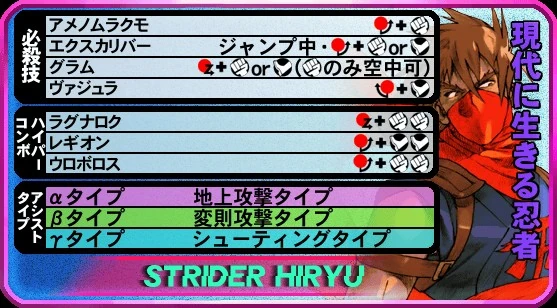

Hiryu's movelist card from Marvel vs. Capcom 2
This subpage lists all of Hiryu's moves from the Marvel vs. Capcom series. The movelist has been largely unchanged since Marvel vs. Capcom: Clash of Super Heroes, only receiving performance tweaks in Marvel vs. Capcom 2 and Ultimate Marvel vs. Capcom 3, and a number of changes and a few new moves (including a new Hyper Combo) in Marvel vs. Capcom: Infinite.
Command Normals[]
Command Normals or Unique Moves (特殊技; lit. Unique Arts) are basic techniques executed by a single direction and attack combination. They usually possess unique properties when compared to normal attacks, while having similar chain-cancel rules.
Slide[]
Slide (スライディング; lit. Sliding) is a quick low-hitting maneuver, where Hiryu rolls forward and performs a quick sliding kick. The attack is fast and hits low, and can hit downed opponents. However in Ultimate Marvel vs. Capcom 3, it is no longer cancel-able into from any of his normals, nor is it cancel-able into anything if it hits; only an Assist as well as X-Factor activation. Although in Marvel vs. Capcom: Infinite, the Slide
Origin: The Slide attack is one of Hiryu's original techniques from the Arcade game, which Hiryu uses in all follow-ups as well as in most crossover appearances.
Arch Cut[]

Arch Cut (斬り払い; lit. Cutting Sweep) is a basic move where Hiryu pivots into an outward-turning slash at a slight downwards angle with a slight forward lean. Originally his standing Heavy Kick (HK) normal attack, it became a command normal/unique move in Ultimate due to the new button layout. Though in Marvel vs. Capcom 2, both it and his standing Heavy Punch also inflicted a small knockaway effect on hit, unlike all other incarnations that inflict normal grounded hitstun.
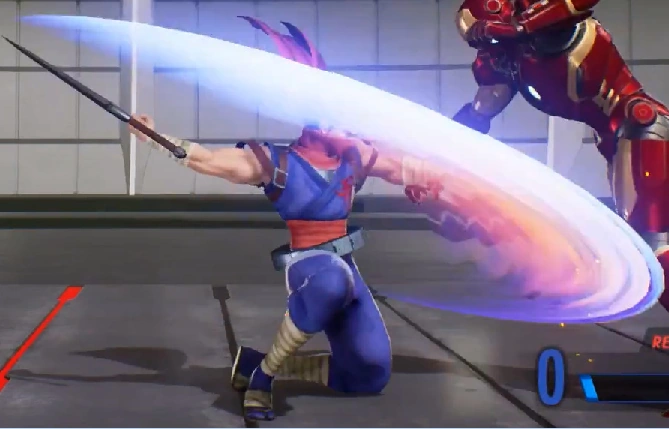

The move was changed for Infinite after the turning slash was assigned back to being Hiryu's standing HK attack. The new Arch Cut is now Hiryu's old crouching Medium Kick/Medium Attack, a back-handed reverse upwards slash where the Cypher is swung up at an angle away (which was the same as his standing, crouching and midair version MK normals).
Lateral Slice[]
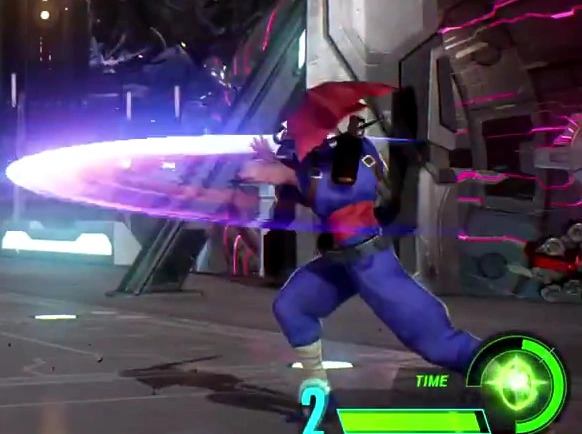

Lateral Slice (横薙ぎ; lit. Sideways Mower) is a new command normal introduced in Infinite, a quick inward horizontal slashing reap. This is one of Hiryu's original normal attacks (standing Medium Punch/Attack) repurposed as a command normal. It has an airborne version called Aerial Lateral Slice (空中横薙ぎ; lit. Midair Sideways Mower), which was his original jumping Medium Punch/Attack. This same inwards cutting animation was of course, originally used for Hiryu's Medium Punch animations (for standing, crouching and midair).
Origin: The fully horizontal slash was inspired by Hiryu's attack animation in Strider, which consists of a fast, fully horizontal strike of the Cypher, via an inward swing.
Special Moves[]
Special Moves (必殺技; lit. "Sure-Killing Arts") are techniques and abilities with their own properties, used by a combination of several directions and an attack button. The strength of the attack button used (weak/light, medium and strong/heavy) often determines the properties of the technique, such as the range or speed of the attack, without altering the technique itself. For the most part, it is common for special moves to also inflict a minor amount of chip/scratch damage when blocked in many fighting games.

Ame-no-Murakumo[]
Ame-no-Murakumo (アメノムラクモ) is a forwards advancing slash attack. Hiryu dashes forward and does a turning outward-leaning slash, using the same standing Heavy Kick/Arch Cut animation. The strength of the button used determines how far Hiryu sprints forward, with the light version having him move not as far while being the quickest one to chain-combo into. Heavier button versions however, have Hiryu recover faster after the slash.
It initially had afterimages trailing after Hiryu to distinguish it from his standing Heavy Kick animation, though the plasma edge was recolored blue for Ultimate and Infinite as a way to separate it from normal slash attacks. However, the afterimages are not present in Ultimate, but they return in Infinite.
Ame-no-Murakumo also appears as one of Hiryu's attacks in Project X Zone 2 and one of the card skills in Street Fighter × All Capcom, while Hiryu's running slash in the 2014 Strider and old Zeku's Bushin Murakumo from Street Fighter V both are inspired by this move.
Origin: Named after the Kusanagi-no-Tsurugi (Sword-of-the-Grass Mower) from Japanese folklore, whose original name is Ame-no-Murakumo-no-Tsurugi (Sword-of-the-Gathering-Clouds-of-Heaven); the former name was given upon Susano'o giving the sword to Amaterasu as a present.

Gram[]
Gram (グラム) is a quick ranged attack. Hiryu does a horizontal Cypher slash with the reach of the plasma blade extended. Depending on the strength of the button used, the plasma blade can extend in front of him, half-screen or full-screen. Hiryu can also do it while airborne (where he slowly floats down to the ground and only lands after the animation finishes) and has a second, crouching variation.
In Ultimate and Infinite, the crouching variation is removed and like Ame-no-Murakumo, the plasma edge is recolored blue. The move's animation is the same as his standing, crouching and jumping Medium Punch attacks. In Infinite, the move's motion has also changed.
Gram also appears as one of Hiryu's attacks in Namco x Capcom, Project X Zone 2 and the cancelled Capcom Fighting All-Stars, while the animation of the Charged Cypher technique from the 2014 Strider and Zeku's Bushin Gram in Street Fighter V are both inspired by Gram.
Origin: The attack is named after the Gram, a mythical sword from Norse Mythology. The attack itself seems inspired by the Cypher Power-Up item in the Arcade game, which provides extended range for a limited time.
Excalibur[]
Excalibur (エクスカリバー) is an aerial multi-hit attack. Hiryu does a flying dash in mid-air and slashes any enemy crossing his path. One can determine its direction (up or down) and angle by the attack button used (punch angles go upwards, kick angles go downwards), though Ultimate reduced the angle options to only 3 (steep-downwards, straight-forward and steep-upwards). Meanwhile, both Marvel vs. Capcom 2 and Infinite provide only 4 angles instead, with the latter game removing the directly-horizontal angle.
Excalibur also appears as one of Hiryu's attacks in Project X Zone 2 and one of the card skills in Street Fighter × All Capcom, while Hiryu's sprite while doing the Hassou Jump is drawn based on Excalibur's pose. Hiryu's Plasma Catapult from the 2014 Strider is possibly based on this move as well.
Origin: Excalibur is the well-known sword wielded by King Arthur.
Warp[]
Warp (ワープ) is a teleport move, which allows Hiryu to instantly move around the screen, with the height and position of his reappearance depending on the button used. In Ultimate, the technique was merged into Vajra (becoming Vajra's weak and medium strength variations) and the ability to determine height was removed.
This technique was meant to be part of Hiryu's moveset in Capcom Fighting All-Stars.

Vajra[]
Vajra (ヴァジュラ) is an advanced teleport move. Hiryu teleports like normal, then three images of him appear in midair and perform a diving kick, converging on the spot. In Ultimate, Vajra is simplified slightly, and the weaker button variations become a simple teleport which replaces his original Warp naming. In Infinite, Hiryu gains a 4th variation where he teleports directly into a Wall Climb.
Hiryu and Hien both use it as a counter move in Namco × Capcom, it appears as a card skill in Street Fighter × All Capcom, and Hiryu performs the move as part of one of his combos in Project X Zone 2.
Origin: Named after the adamantine/diamond thunderbolt from Hindu mythology, which was the primary weapon of the Hindu god, Indra.

Formation[]
The Formation (フォーメーション) set are three summoning techniques involving the Options. They are known as Formation A (divided into Formation A1 and Formation A2 in Ultimate), Formation B and Formation C, and each calls one of the Option robots to assist Hiryu in the fight.
In Infinite, Formation A1 and A2 have become Command Normals with a simplified input, and when the Options are summoned, they stop for a second to pose before launching at the enemy.

- Formation A1: Hiryu points forward and calls forth the Option B (Terapodal Robo-panther), which comes running across the screen and hits the enemy in its way.
- Formation A2: Hiryu points forward and calls forth the Option C (Robot Hawk), which comes flying across the top-half of the screen, hitting the enemy in its path. This technique was first introduced in Marvel vs. Capcom 2.
- Formation B: Hiryu summons an Option A (Dipodal Saucer), which remains floating next to him until it is used or Hiryu is hit.
- Formation B (Shot) (フォーメーションB・シュート, lit. Formation B: Shoot): Repeating the move's command again sends the Saucer forward as a projectile engulfed in flames.
- Formation C: Hiryu calls forth an Option C, which comes carrying a parachute bomb ready to be dropped at the enemy. The bomb can hit either on contact or on its way down. The strength of the button used determines how far or close to Hiryu the bomb is dropped.
Formation A1, A2 and B appear as part of Hiryu's combos in Project X Zone 2, while Formation A is a card skill in Street Fighter × All Capcom. Zeku's two V-Skill II, Kuchiyose Bii and Shii, are based on Formation A1 and C respectively. Hiryu's third Hero Art in TEPPEN is called "Formation" and employs Option A, but its animation shows Hiryu using the Option's shield ability from the 2014 Strider, something none of the Formation attacks do.
Origin: Mostly loosely based on how the Options work in the Arcade game, though Formation B and Formation C are entirely original in their function. The parachute bomb from Formation C is taken from an obstacle found in the second stage, Siberia.
Wall Climb[]
Wall Climb (壁張り付き; lit. Wall Cling) is a special stance technique, in which Hiryu jumps to either side of the screen and clings to it. During this stance, Hiryu can move up or down, dismount off the wall or perform several moves:
- Cypher Strike (サイファー攻撃, lit. Cypher Attack): Hiryu does a quick slash with his Cypher. Renamed in the localized script as Cypher Lateral Slice in Infinite, to match the name of the new command normal.
- Jump Attack (飛び蹴り, lit. Jumping Kick): Hiryu does a diagonal descending flying kick. In the first two games it was called Jimen ni Tobigeri (地面に跳び蹴り; lit. Jumping Kick to the Ground). Renamed Leaping Kick in Infinite.
- Ladder Kick (下蹴り; lit. Lower/Down Kick): Hiryu does a down-sliding heel strike downwards to stomp-kick enemies just below him along the wall. Called the Sliding Kick (スライディングキック) in the previous games.
- Wall Exchange (壁渡り; lit. Wall Transition): Hiryu launches himself towards the opposite wall. Called the Opposite Wall Switch (反対側の壁移動; lit. Opposite Sided-Wall Movement) in the previous games.
- Raikiri Slash (雷切; lit. Thunder Cutter): A new move introduced in Infinite. Hiryu propels himself off the wall horizontally, and then drops down vertically as he performs a downward circular slash at the opposite direction.
Origin: Based on one of the Arcade game's best known features: the ability to cling onto any wall or ceiling and move across it. The Wall Exchange would later be adapted into the Hasshou Jump in Strider 2. The Raikiri Slash refers to the Raikiri (雷切, Thunder Cutter), a famous sword wielded by the Sengoku era samurai Tachibana Dōsetsu, which was originally named Chidori (千鳥, Thousand Birds).
Hyper Combos[]
Hyper Combos (ハイパーコンボ) are the Superhero vs. Capcom games' naming convention for Super Special Moves or Super Moves. Such are usually categorized as the strongest type of moves, requiring more complex button combinations and at least 1 level of Hyper meter. These are often more powerful than Special Moves (and at times are directly-stronger versions of them as separate attacks for a number of characters), with the same varied properties per character as Special Moves themselves. Starting with Marvel vs. Capcom 3 (a carryover from Tatsunoko vs. Capcom), most characters are assigned a more powerful (and often cinematic) Hyper Combo that costs 3 levels of Hyper meter instead of 1 (even though very few characters actually had actual Level 3 Hyper Combos).
Ouroboros[]

One of Hiryu's most well-known moves, Ouroboros (ウロボロス) has Hiryu summon two Dipodal Saucers to his aid, which start spinning around him rapidly. While in this state, both Saucers can damage on contact and shoot a ring laser whenever Hiryu attacks; the Saucers then skitter away along the ground after the duration ends.
Originally a Level 1 Hyper, Ultimate turned Ouroboros into a Level 3 Hyper Combo, while making it faster and stronger than the old version, but at the cost of only the projectiles no longer inflicting chip damage if blocked (preventing it from being as oppressive when used for blockstrings). The Saucers themselves during their orbit however, still inflict chip damage when blocked.
Infinite brought Ouroboros back to being a Level 1 Hyper Combo, and reduced the orbiting speed on the Options.
Originally, Ouroboros was the most-preferred Hyper Combo to use due to the combo extendability and damage it grants while locking the enemy in continuous hitstun (or in blockstun to repeatedly chip their HP out with other assists before the nerfs in Ultimate). Since Marvel vs. Capcom 2, no other Hyper Combos can be performed while this move is active. However, in Ultimate Marvel vs. Capcom 3 and Infinite, Hiryu also cannot build any Hyper gauge levels whenever Ouroboros is active.
While he yells out the name of the move in Ultimate and Infinite's English script, he instead yells out "Formation!" in the Japanese script in the former game.
Ouroboros is featured as part of Hiryu's Special Move in Project X Zone 2 and one of the card skills in Street Fighter × All Capcom. The way the Option A summon functions in the 2014 Strider is also inspired by this move.
Origin: Named after the symbol of eternity symbolized by a snake eating its own tail while in a cycle. While Ouroboros is also a stage boss in the Arcade game, the attack is likely named after the circular/looping movement the Saucers do. The way the Saucers function in this Hyper Combo also closely mimics their use in the Arcade game, with both moving around Hiryu and shooting whenever he attacks.


Legion[]
In Legion (レギオン), Hiryu summons several robot panthers and hawks, all of whom rush across the screen hitting the opponent on their path. The technique is fast and easy to follow-up, but in contrast has low damage output. In Ultimate, Legion is made both faster and able to cover more screen space and causes Hiryu to fall back further away from the enemy, as well as being able to pick-up a downed opponent via OTG while still low on overall damage.
Legion is referenced as a skill name in Namco × Capcom, and was later used as part of Hiryu's Support Attack in Project X Zone 2 and as his 1st Hero Art in TEPPEN.
Origin: Named after a group of demons from the Bible.


Ragnarok[]

Hiryu's cinematic Hyper Combo which was originally Level 1, Ragnarok (ラグナロク) became his second Level 3 Hyper Combo in Ultimate.
Hiryu dashes forward and tries to grab the enemy. If he connects, the enemy is thrown up into the air (via Hiryu carrying them up before he vanishes), where several Hiryu images attack with continuous slash-through-strikes at the victim before finishing with four images converging for a final crossing dive kick (Vajra), as Hiryu teleports beside his fallen enemy in front as they hit the ground.
Ultimate and Infinite grants this Hyper Combo massive invincibility upon startup and inflicts un-scaled damage, while also changing the cinematic instead to have the Hiryu images successively dive at his opponent in rapid succession; the final blow instead involves 3 Hiryu images simultaneously crossing-through the victim in a triangular formation, Cypher-slashing them with a growling sound being heard just before they connect. Hiryu then lands facing away from his victim as they spin-out back to the ground.
Ragnarok appears in Namco × Capcom as Hiryu's Special Move, and returns (updated to its Ultimate version) as the final part of Hiryu's Special Move in Project X Zone 2; it also appears as a card skill in Street Fighter × All Capcom and as his 2nd Hero Art in TEPPEN. A watered-down version was also seen as his Level 3 Super Art in Capcom Fighting All-Stars, and Zeku's Critical Art Batsuzan Gaisen from Street Fighter V is partly inspired by this Hyper Combo as well.
Origin: Named after the Ragnarok, a series of events in Norse Mythology said to foretold the end and rebirth of the world.


Brionac[]
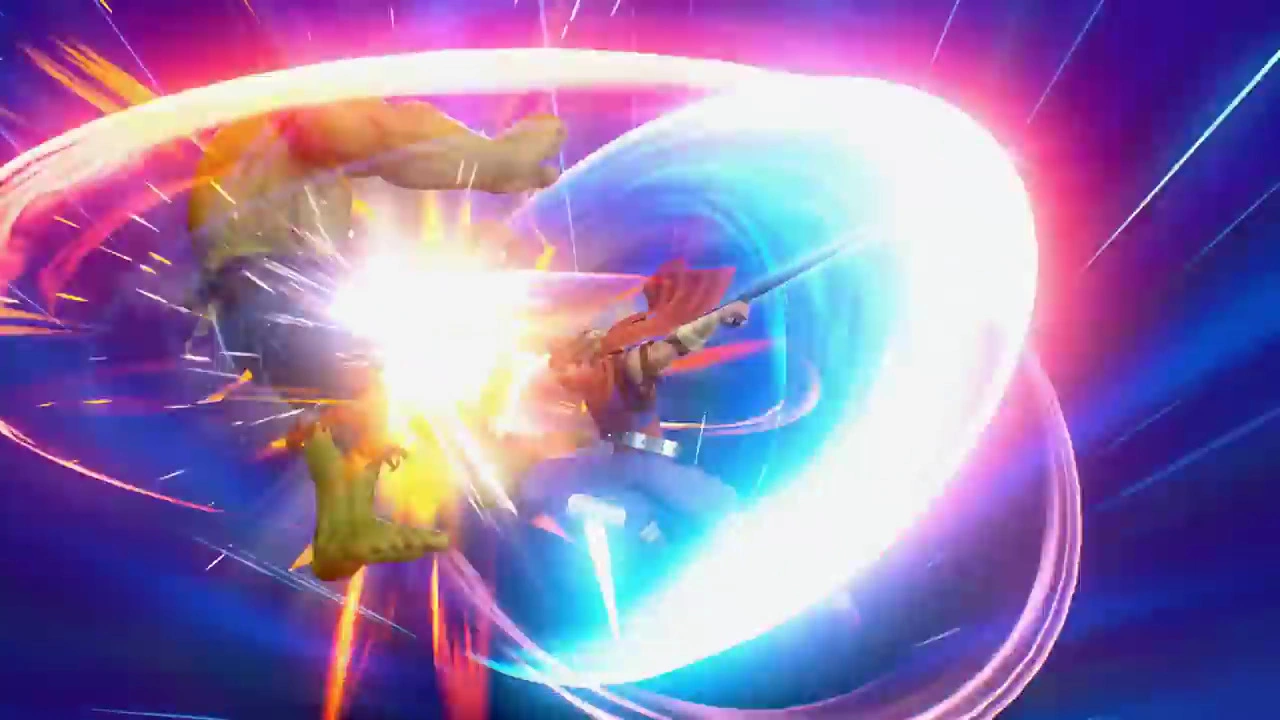

Brionac (ブリューナク) is a new Hyper Combo introduced in Infinite. An air-only technique, Brionac consists of a quick multi-directional slash attack in which Hiryu tumbles and spins around at high speed while in mid-air, generating blade slashes in quick succession appearing all around him. The move is intended as an Hyper Combo ender for aerial combos, something Hiryu lacked in previous games.
Origin: A term exclusive from Japanese pop culture, "Brionac" is a name allegedly ascribed to Lugh's infallible spear from Celtic mythology. In truth the name has no basis in any known Celtic mythological text, where Lugh's spear is not given any specific name. Nonetheless, it has become a popular mythological term used in Japanese media for fictional depictions of Lugh, or as a name for powerful/magical spears in general. The move itself is inspired by the Savage Slash, a technique used by Hiryu in Strider 2.
Other Animations[]
Movement[]


Attacks[]


